|
|
|


|
Brief Account of a General Mathematical Theory of Political Economy |
|
|
|
|
Brief Account of a General Mathematical Theory of Political Economy |
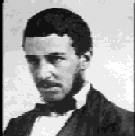
William Stanley Jevons
Economista inglês, nascido em 01 de setembro de 1835, na cidade de Liverpool, Inglaterra. Falecido em 13 de agosto de 1882, em Bexhill, próxima de Hastings. Economista precursor da Teoria da Utilidade Marginal e de várias metodologias matemáticas em Economia Política. Sua principal obra é "Teoria da Economia Política", de 1871.
Account_of_Mathematical@revistapraxis.cjb.net
Publicado originalmente em Journal of the Royal Statistical Society, vol. XXIX, London, Junho de 1866, pp. 282-87.
Lido pela primeira vez na Seção F da British Association, 1862.
(Texto Original em inglês)
1) The following paper briefly describes the nature of a Theory of Economy which will reduce the main problem of this science to a mathematical form. Economy, indeed, being concerned with quantities, has always of necessity been mathematical in its subject, but the strict and general statement, and the easy comprehension of its quantitative laws has been prevented by a neglect of those powerful methods of expression which have been applied to most other sciences with so much success. It is not to be supposed, however, that because economy becomes mathematical in form, it will, therefore, become a matter of rigorous calculation. Its mathematical principles may become formal and certain, while its individual data remain as inexact as ever.
2) A true theory of economy can only be attained by going back to the great springs of human action ― the feelings of pleasure and pain. A large part of such feelings arise periodically from the ordinary wants and desires of body or mind, and from the painful exertion we are continually prompted to undergo that we may satisfy our wants.
Economy investigates the relations of ordinary pleasures and pains thus arising, and it has a wide enough field of inquiry. But economy does not treat of all human motives. There are motives nearly always present with us, arising from conscience, compassion, or from some moral or religious source, which economy cannot and does not pretend to treat. These will remain to us as outstanding and disturbing forces; they must be treated, if at all, by other appropriate branches of knowledge.
3) We always treat feelings as being capable of more or less, and I now hold that they are quantities capable of scientific treatment.
Our estimation of the comparative amounts of feeling is performed in the act of choice or volition. Our choice of one course out of two or more proves that, in our estimation, this course promises the greatest balance of pleasure. When there is a large overbalancing force on one side, indeed, the estimation of the amount of this balance is no doubt very rude; but all the critical points of the theory will depend on that nice estimation of the opposing motives which we make when these are nearly equal, and we hesitate between them.
4) As several writers have previously remarked, feelings have two dimensions, intension and duration. A pleasure or a pain may be either weak or intense in any indivisible moment; it may also last a long or a short time. If the intensity remain uniform, the quantity of feeling generated is found by multiplying the units of intensity into the units of duration. But if the intensity, as is usually the case, varies as some function of the time, the quantity of feeling is got by infinitesimal summation or integration.
Thus, if the duration of a feeling be represented by the abscissa of a curve, the intensity will be the ordinate, and the quantity of feeling will be the area.
5) Pleasure and pain, of course, are opposed as positive and negative quantities.
6) A principle of the mind which any true theory must take into account is that of foresight. Every expected future pleasure or pain affects us with similar feelings in the present time, but with an intensity diminished in some proportion to its uncertainty and its remoteness in time. But the effects of foresight merely complicate without altering the other parts of the theory.
7) Such are the main principles of feeling on which economy is founded. A second part of the theory proceeds from feelings to the useful objects or utilities by which pleasurable feeling is increased or pain removed.
An object is useful when it either affects the senses pleasurably in the present moment, or when, by foresight, it is expected that it will do so at some future time. Thus we must carefully distinguish actual utility in present use from estimated future utility, which yet, by allowing for the imperfect force of anticipation, and for the uncertainty of future events, gives a certain present utility.
8) Amount of utility corresponds to amount of pleasure produced. But the continued uniform application of au useful object to the senses or the desires, will not commonly produce uniform amounts of pleasure. Every appetite or sense is more or less rapidly satiated. A certain quantity of an object received, a further quantity is indifferent to us, or may even excite disgust. Every successive application will commonly excite the feelings less intensely than the previous application. The utility of the last supply of an object, then, usually decreases in some proportion, or as some function of the whole quantity received. This variation theoretically existing even in the smallest quantities, we must recede to infinitesimals, and what we shall call the coefficient of utility, is the ratio between the last increment or infinitely small supply of the object, and the increment of pleasure which it occasions, both, of course, estimated in their appropriate units.
9) The coefficient of utility is, then, some generally diminishing function of the whole quantity of the object consumed. Here is the most important law of the whole theory.
This function of utility is peculiar to each kind of object, and more or less to each individual. Thus, the appetite for dry bread is much more rapidly satisfied than that for wine, for clothes, for handsome furniture, for works of art, or, finally, for money. And every one has his own peculiar tastes in which he is nearly insatiable.
10) A third part of the theory now treats of labor; which, although the means by which we seek pleasure, is always accompanied by a certain painful exertion, rapidly increasing as some function of the intensity or the duration of the labor. Thus, labor will be exerted both in intensity and duration until a further increment will be more painful than the increment of produce thereby obtained is pleasurable. Here labor will stop, but up to this point it will always be accompanied by an excess of pleasure.
It is obvious that the final point of labor will depend upon the final ratio of utility of the object produced.
11) I assume, as obviously true, that the abilities of men are infinitely varied, whether by nature or by education, so that both the same person may vary in his power of producing different objects, and any two persons may vary in respect of the same object.
This, indeed, is in direct opposition to the erroneous simplification of the science effected by Ricardo, when he assumed that all laborers have a certain uniform power; the higher classes of mechanics and other skilled or learned producers being treated as mere exceptions to the rule.
12) The theory of rent, which here comes in, is not materially different from that of Dr. Anderson and later writers.
13) We now arrive at the theory of exchange, which is a deduction from the laws of utility.
If a person has any useful object, but an object belonging to another person would have greater utility, he will be glad to give the one in return for the other. But it is a necessary condition that the other person will likewise gain, or at least not lose by the exchange.
Whether the exchange will take place or not can only be ascertained by estimating the utility of the objects on either side, which is done by integrating the appropriate functions of utility up to the quantity of each object as limits. A balance of utility on both sides will lead to an exchange.
14) Suppose, however, that the useful objects on either side are commodities of which more or less may be given, and this even dow to infinitely small quantities. Such is substantially the case in ordinary commercial sales. There are now no definite amounts of utility to be balanced against each other, but the one person will now give to the other so much of his commodity, and at such a ratio of exchange, that if he gave an infinitely small quantity, either more or less, but at the same rate, he would not gain in utility by it. The increments of utility lost and gained at the limits of the quantities exchanged must be equal, otherwise further exchange would take place.
The ratio of the increments of the commodities, however, would be indeterminate but for the existence of a law that all quantities of the same commodity, being uniform in kind, must be exchanged at the same rate. The last increments, then, must be exchanged, in the ratio of the whole quantities exchanged. To explain in ordinary words how the adjustment takes place under this condition is almost impossible. But light is at once throw on the whole matter by stating that in every such exchange we have two unknown quantities and two equations by which to determine them. The unknown quantities are the quantities of commodity given and received. The know quantities are those of the commodities previously possessed. We have also the functions of utility of the commodities with the respect to the persons. An equation may thus be established on either side between the utility gained and sacrificed at the ratio of exchange of the whole commodities, upon the last increments exchanged.
15) When the useful object on one side only is infinitely divisible, we shall have only one unknown quantity, namely, that of the divisible commodity given for the indivisible object, and also one equation to determine it by, namely, that on the part of the person holding the divisible commodity, and able to give more or less for it. But this does not apply to unique objects, like a statue, a rare book, or gem, which do not admit of the conception of more or less.
When both commodities are indivisible as first supposed (section 15), we have neither unknown quantities nor equations.
16) The equations in an exchange may prove impossible, or without solutions. This will indicate either that no exchange of commodity can take place at all, or that at least one of the parties to the exchange is not satisfied even with the whole of the commodity formerly belonging to the other.
17) The principle of exchange thus deduced in the case of two persons and two commodities, applies to any number of persons and commodities. It, therefore, applies not only to the general inland trade of a country, but to the trade between aggregates of men or nations ― international trade.
The number of equations is very rapidly increased according to the simple law of combinations.
18) Of course such equations as are here spoken of are merely theoretical. Such complicated laws as those of economy cannot be accurately traced in individual cases. Their operation can only be detected in aggregates and by the method of averages. We must think under the forms of these laws in their theoretic perfection and complication; in practice we must be content with approximate and empirical laws.
19) Let it be remarked, that though the exchanges be regulated by equations, there cannot be equality in the whole utilities gained and lost, which are found by integrating the functions of utility of the respective commodities before and after exchange.
The balance is the gain of utility, and from the nature of exchange there must be a gain on one side at least.
20) Combining the theory of exchanges with that of labor and production, the quantity which each person produces will be dependant upon the result of the exchanges; for this may greatly modify the conditions of utility.
A new set of unknown quantities are thus introduced; but it will he found that just as many new equations to determine them may be established. Each such equation is between the utility of the last increment of produce and the increment of labor necessary to produce it.
21) The only further part of the theory which I will here at all attempt to explain is that referring to capital. I shall give a definition of capital different from the established one, and much simpler. Mr. J.S. Mill says (Principles, 3rd edition, vol. I, p. 67), "What capital does for production is to afford the shelter, protection, tools and materials which the work requires, and to feed and otherwise maintain the laborers during the process."
To understand capital properly, we must omit all but the last enumerated part. Thus, I define capital as consisting of all useful objects which, in supplying a laborer's ordinary wants and desires, enable him to undertake works of which the result will be deferred for a greater or less space of time. Capital, in short, is nothing but maintenance of laborers.
It is, of course, perfectly true that buildings, tools, materials, &c., are a necessary means of production; but they are already the product of labor assisted by capital or maintenance. They are the results of the application of capital to labor at an imperfect stage.
Without capital a person must have immediate returns, or else he perishes. With capital he may sow in the spring that he may reap in the autumn; or he may undertake labor-saving enterprises, such as roads and railways, which will not make a full return for many years. Most improved modes of applying labor require that the enjoyment of the result shall be deferred.
22) While amount of capital is estimated by the amount of utility of which the enjoyment is deferred, amount of employment of capital is the amount of utility multiplied by the number of units of time during which its enjoyment is deferred.
23) The interest of all capital in a market is of one rate only, and that, therefore, the lowest rate; because capital consists only in maintenance, and may therefore be applied indifferently to any branch of industry. Buildings, tools, &c., which have hitherto been classed with capital, are, on the contrary, usually applicable only to the single purpose for which they were designed. The profit they bring, therefore, in no way follows the laws of the interest of capital, but rather those of rent, or the produce of natural agents. This has been already remarked by Professor Newman, in his Lectures on Political Economy, and by other writers.
24) As labor must be supposed to be aided with some capital, the rate of interest is always determined by the ratio which a new increment of produce bears to the increment of capital by which it was produced. As the interest of all capital must be uniform, the benefit which the mass of capital already available confers upon the laborer goes for nothing in determining the rate of interest, which depends solely upon the portion last added, or which may be added.
25) We can now easily explain the known fact, that the interest of capital always tends to fall very rapidly as its amount increases, in proportion to the labor it supports. It is because for equal increments of time the necessary increments of capital increase with the time. Thus, if I undertake a work which I can finish in one year, I have to await the result on an average only half a year. If, however, I work a second year before getting the result, I wait a whole year for the former year's work and half a year for the second year's work. Thus I employ at least three times as much capital in the second year as in the first. In the third year I should employ at least five times as much capital, in the fourth year at least seven times, and so on. Unless, then, the advantages of the successive deferments increase in the arithmetical series 3, 5, 7, 9, &c., the proportional profit from the new additions must fall, and, as was said before, the lowest rate for which capital may be had governs the rate of all other capital.
26) It is the accepted opinion of writers of the present day, that the rate of interest tends to fall because the soil does not yield proportionate returns as its cultivation is pushed. But I must hold that this decrease in the proportionate returns would chiefly fall upon the wages of the laborer. The interest of capital has no relation to the absolute returns to labor, but only to the increased return which the last increment of capital allows.
27) Having thus explained some of the principal features of the theory, I shall close without venturing into the higher complications of the subject, where the effects of money, of credit, of combination of labor, of the risk or uncertainty of undertakings, and of bankruptcy, are taken into account.
The last result of the theory will be to give a determination of the rates of wages, or the produce of labour after deduction of rent, interest, profit, insurance and taxation, which are so many payments which the labourer makes for advantages enjoyed.
Caro Leitor, esperamos que a leitura deste artigo do economista inglês William Stanley Jevons, um dos Clássicos das Ciências Econômicas, tenha sido proveitosa, instrutiva e agradável. Mande-nos um E-mail ou escreva-nos, dando suas impressões e comentários sobre o texto e sua apresentação. Ficaremos honrados em receber sua correspondência, também com suas críticas e comentários.
São permitidas a reprodução, distribuição e impressão deste texto com a devida e inalienável citação da sua origem. © Direitos reservados ao Autor, seus Herdeiros, seu Tradutor e seus Editores.
 Retornar ao início da página
 Clique aqui para acessar a Primeira Página da Revista Práxis na Internet.
Clique aqui para acessar a Lista de Clássicos do Pensamento Universal, apresentados pela Revista Práxis na Internet. 
Conheça o Conteúdo Completo da Revista Práxis na Internet, divisões por Temas, Obras e Autores.
Clique aqui para acessar a Lista de Artigos, Ensaios e Resenhas publicados pela Revista Práxis na Internet.
Clique aqui para acessar a Lista de Autores publicados pela Revista Práxis na Internet.
Clique aqui para acessar o Conteúdo por Assuntos da Revista Práxis na Internet.
Clique aqui para conhecer a Lista de Resenhas e Críticas Literárias publicadas pela Revista Práxis.
Clique aqui para acessar a Lista de Artigos e Trabalhos apresentados em Eventos promovidos com a participação da Revista Práxis.
Clique aqui para acessar o Banco de Imagens da Revista Práxis na Internet. São centenas de imagens, fotografias, filmes, discursos e falas originais que mostram o movimento ascendente dos povos. Com thumbnails (miniaturas de amostra). 
Clique aqui para participar de uma conversa ao vivo em nossa Sala de Bate-Papo on-line (Chat).
 Para contatar a Revista Práxis na Internet, mande um e-mail para rvpraxis@horizontes.net Gracias por su contacto. Your comments are important to us.
Para contatar o WebMaster da Revista Práxis na Internet, mande um e-mail para wmpraxis@horizontes.net.
|
|
Néliton Azevedo - Editor, WebMaster. © Revista Práxis, 2003.
Derechos Reservados. All rights reserved.